High-level team health visibility in one place
See the current state of trust, communication, ownership, and team momentum without digging through scattered feedback.
I2We Synergy - More Than The Score. Building champions on and off the court through trust, accountability, and team synergy.

Synergy Team Health gives coaches and leaders a repeatable system to assess trust, communication, role clarity, and accountability. Spot friction early and move from assumptions to decisions.
Most teams do not struggle because of talent. They struggle because of hidden friction, unclear standards, and inconsistent communication.
Small issues stay unspoken until they become behavior problems or performance dips.
Players hear different standards from staff and leaders, causing confusion and hesitation.
Effort and ownership vary across the roster, making consistency hard to sustain.
Each cycle scores five high-impact dimensions and converts them into trends, risk flags, and focused next actions.
How safe players feel to communicate honestly, own mistakes, and rely on each other.
Clarity, tone, and consistency in coach-to-player and player-to-player communication.
Whether athletes understand responsibilities and how their role serves team goals.
Measures follow-through, standard protection, and willingness to self-correct.
How the group responds to pressure, setbacks, and momentum swings.
A closer look at the Synergy Team Health experience, from the main dashboard to the action-ready views coaches can use with staff and leaders.
Swipe through platform screenshots to preview the views teams can use to monitor trends, identify risk areas, and guide the next conversation.
See the current state of trust, communication, ownership, and team momentum without digging through scattered feedback.
Review live snapshots that make it easier to spot shifts in culture, alignment, and player response before small issues become season problems.
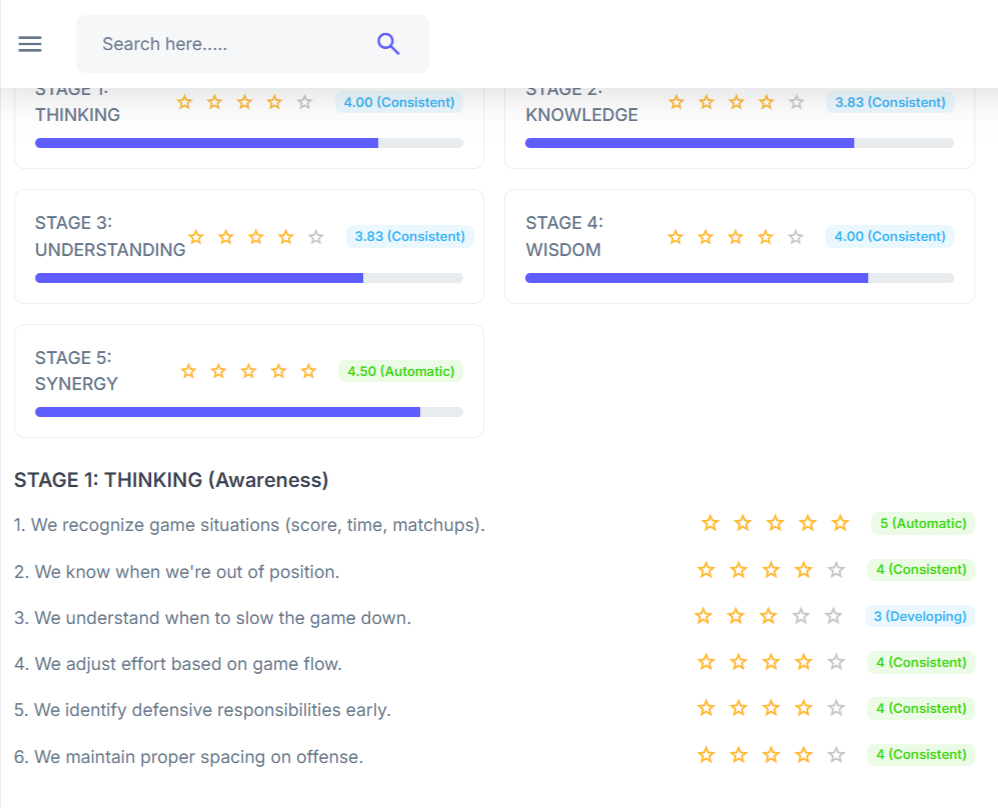
Use the visual reporting layer to understand where your team is stable, where pressure is building, and where leadership attention is needed next.
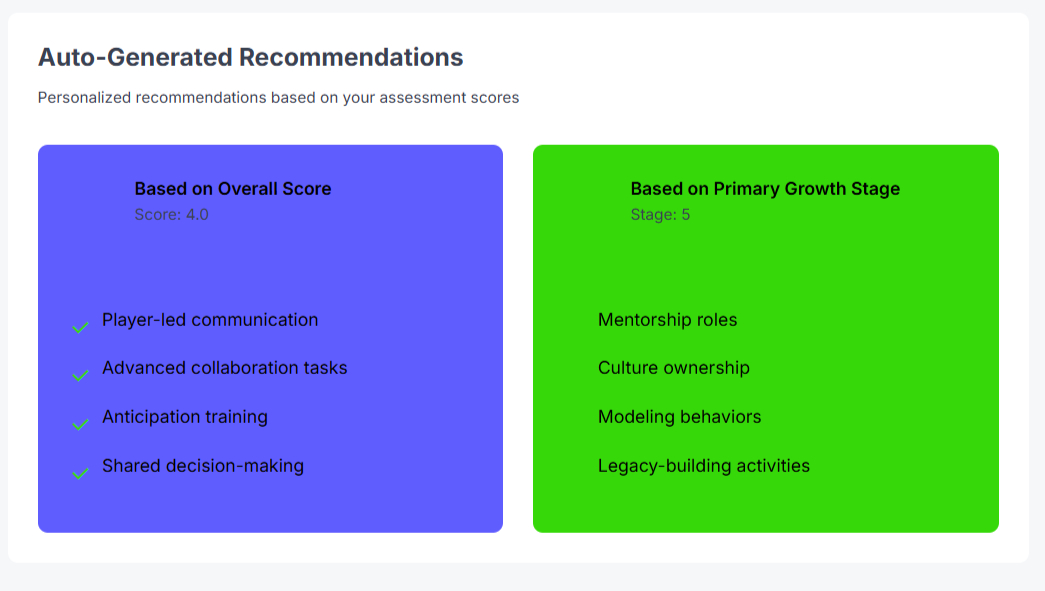
Compare cycles and see whether your interventions are improving clarity, trust, and accountability across the group.
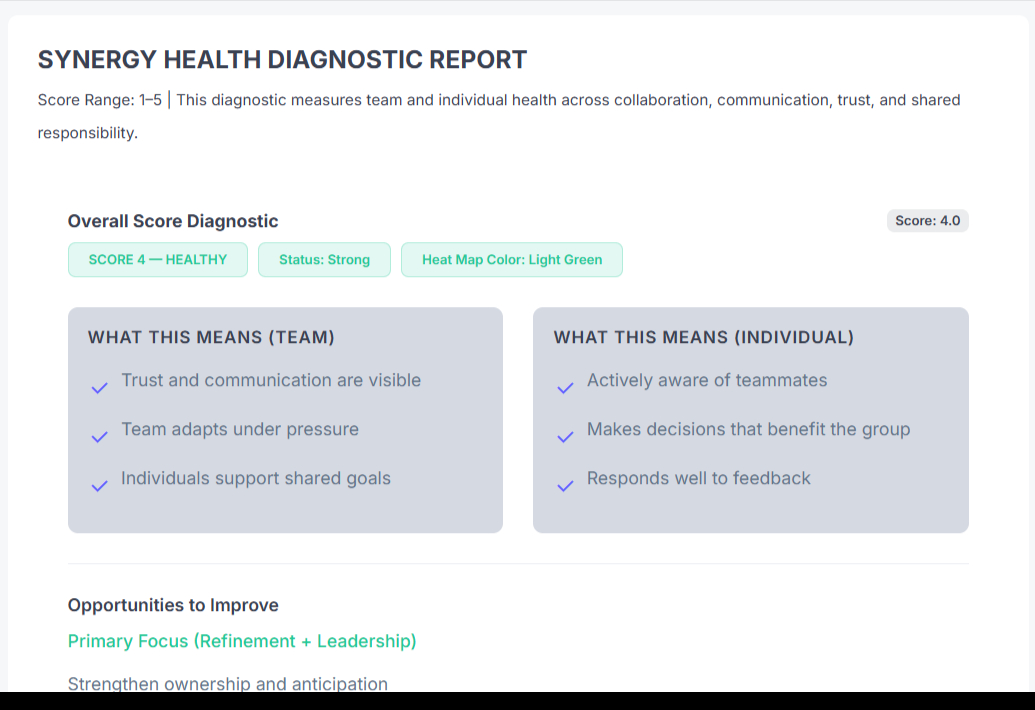
Use the system as a working leadership tool, not just a report, so staff and captains know where to focus next.
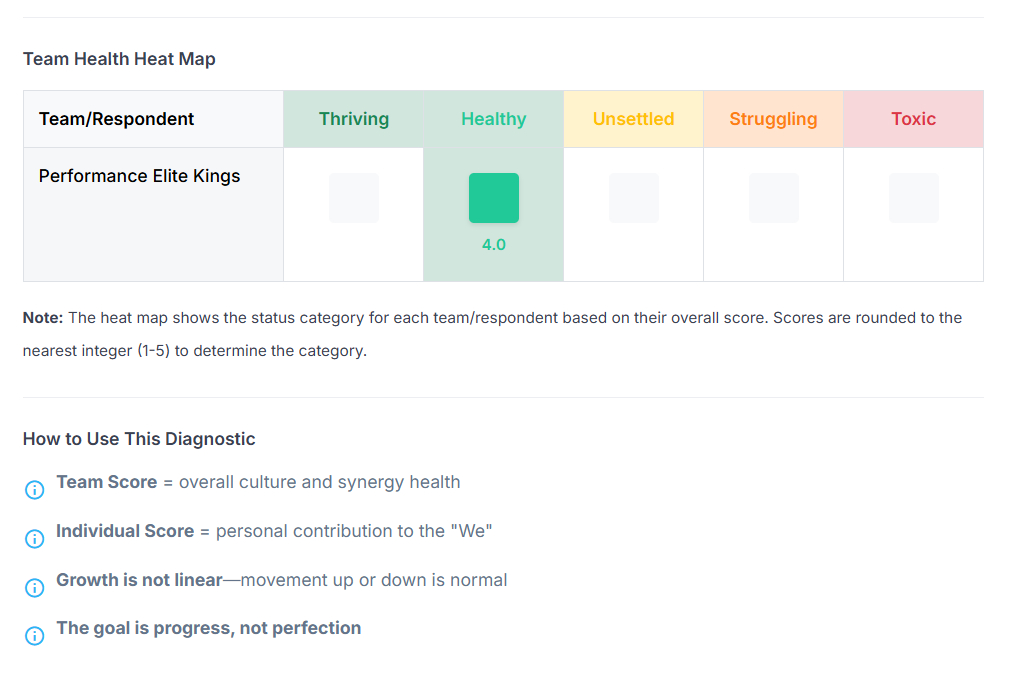
Run in phases so adoption is practical for coaches and sustainable for players.
During Baseline Week, the team completes the I2We Team Health Assessment. Each question is scored from 1 to 5 and grouped into the five synergy stages so leaders can diagnose the current state of team health with something more reliable than assumptions.
The results are then visualized in a Team Health Heat Map. That gives staff an immediate picture of where team dynamics are stable, where they are fragile, and where breakdown risk is highest.
| Synergy Stage | Avg Score | Status | Insight |
|---|---|---|---|
| Thinking | 2.8 | Transitional | Individual awareness is inconsistent. |
| Knowledge | 3.6 | Strength | Communication foundation is solid. |
| Understanding | 2.4 | Risk Zone | Emotional awareness gaps are showing up. |
| Wisdom | 3.1 | Transitional | Decisions are happening, but not yet aligned. |
| Synergy | 2.2 | Risk Zone | The team is not yet operating interdependently. |
Breakdown and risk zone.
Transitional and fragile.
Strength and leverage zone.
After reviewing the Heat Map, leaders complete a Gap Analysis that compares leadership perception with the team’s actual experience. This step is designed to align leaders around reality instead of assumptions.
| Stage | Leader Score | Team Score | Gap | Insight |
|---|---|---|---|---|
| Thinking | 4.2 | 3.1 | +1.1 | Leader assumes clarity, but the team does not feel it. |
| Knowledge | 4.0 | 3.8 | +0.2 | Alignment is strong. |
| Understanding | 3.9 | 2.6 | +1.3 | There is a major emotional-awareness blind spot. |
| Wisdom | 4.1 | 3.0 | +1.1 | Decisions feel top-down to the group. |
| Synergy | 4.3 | 2.7 | +1.6 | Cohesion is being overestimated by leadership. |
Aligned.
Watch zone.
Critical awareness gap.
"Our assessment shows we communicate well, but we need to improve how we understand each other and adapt during pressure situations."
The Action Sprint is a 2 to 4 week intervention phase built around the team’s weakest synergy stage. Instead of trying to fix everything at once, the team applies targeted actions to the exact stage that is limiting progress.
Problem: Lack of ownership, preparation, and role clarity.
Success Signal: Team members stop waiting for instructions.
Problem: Information gaps and miscommunication.
Success Signal: Misunderstandings decrease.
Problem: Emotional friction and defensiveness.
Success Signal: Conflict becomes productive rather than personal.
Problem: Decision-making confusion.
Success Signal: The team self-corrects without escalation.
Problem: High potential but inconsistent flow.
Success Signal: The team performs under pressure with trust and coordination.
After the Action Sprint, the team repeats the Team Health Assessment. Leaders compare the new scores against the baseline to validate progress, identify what still limits performance, and decide the next focus.
| Stage | Baseline | After Sprint |
|---|---|---|
| Thinking | 2.8 | 3.3 |
| Knowledge | 3.6 | 3.9 |
| Understanding | 2.4 | 3.2 |
| Wisdom | 3.1 | 3.5 |
| Synergy | 2.2 | 3.0 |
The roadmap works as a repeating development system: Assess, Align, Intervene, Measure, Repeat. Each cycle strengthens alignment and trust, moving teams from individual awareness to collaborative performance and then toward true synergy.
| Stage | Development Focus |
|---|---|
| Thinking | Individual awareness and responsibility. |
| Knowledge | Shared information and expectations. |
| Understanding | Emotional intelligence and empathy. |
| Wisdom | Collaborative decision-making. |
| Synergy | Interdependent team performance. |
More than scores. You get practical clarity for meetings, planning, and team leadership decisions.
Teams that assess consistently correct faster and maintain stronger culture standards.
Quick answers for coaches and program leaders.
Build stronger culture habits, improve team communication, and track progress with a repeatable system.